Notion AI now generates and edits images directly on pages. For builders using Notion as a CMS, this cuts external tool dependencies and changes content workflows.
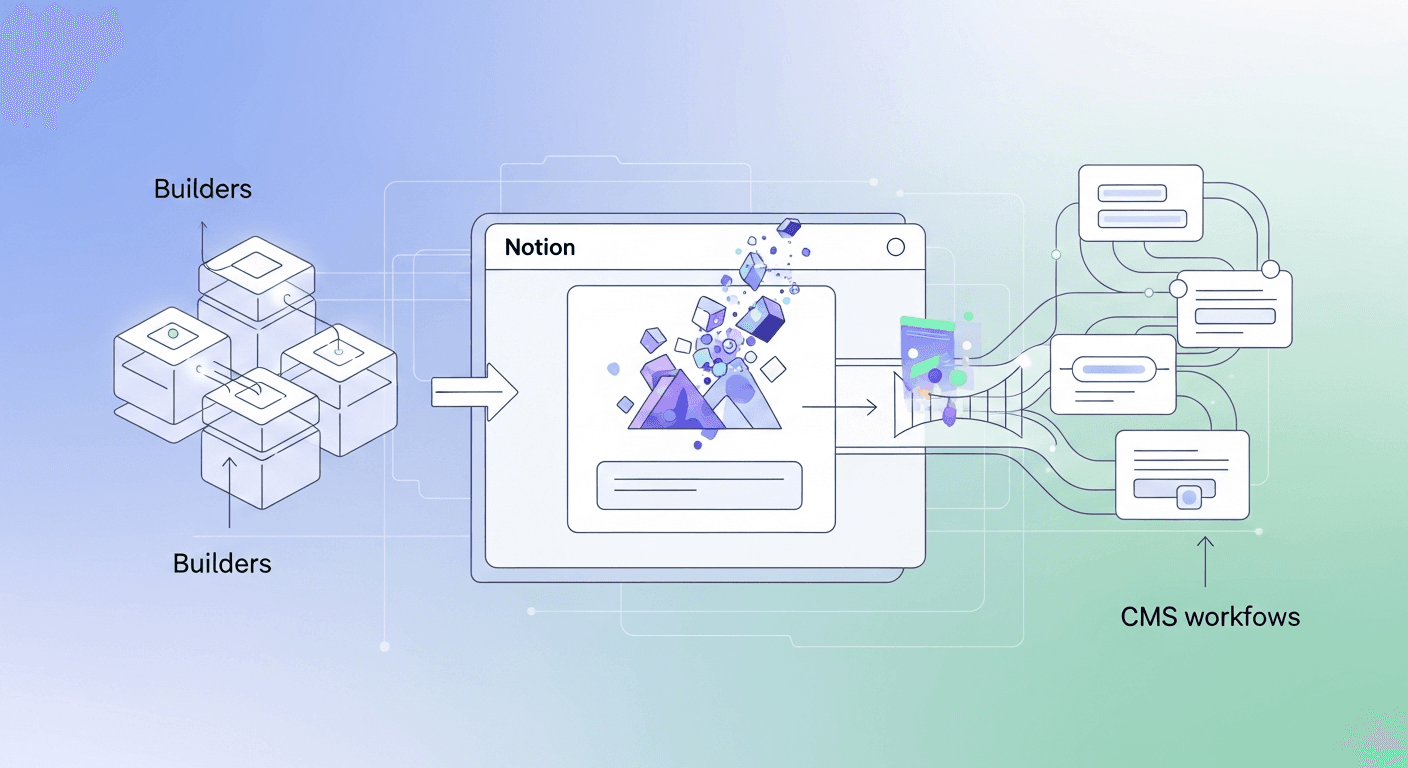
One integrated platform now handles content writing, organization, and visual asset generation—reducing context-switching and lowering the barrier for content teams to include visuals.
Signal analysis
Notion AI expanded beyond text to include native image generation and editing. You can now create cover images, realistic photos, styled charts, diagrams, and slide visuals without leaving Notion. This isn't a separate integration—it's built into the AI assistant alongside existing text features.
The capability spans multiple visual formats: photorealistic images, stylized graphics, data visualizations, and presentation assets. For CMS operators, this means your content pages can now include AI-generated visuals as part of the native workflow, reducing the number of external tools in your stack.
For teams using Notion as a CMS, this is a consolidation play. Previously, generating visual assets meant leaving Notion—Midjourney for art, DALL-E for realistic images, Figma for diagrams. Now those workflows compress. A product manager writing a release post can generate its cover image without alt-tabbing. A content team publishing product documentation can illustrate concepts with AI diagrams inline.
The real shift is operational: fewer API keys, fewer subscriptions, fewer permission layers. Your content creation happens in one place. This reduces context-switching friction and lowers the bar for non-design team members to include visuals.
However, this doesn't replace specialized tools for teams doing high-volume visual production. But for mid-market content teams and builder communities managing documentation, help centers, or marketing content, it's a material upgrade to the Notion CMS value proposition.
This move signals that Notion is filling gaps in its platform using AI rather than building new native features. Image generation isn't new to Notion's architecture—it's an existing AI capability packaged for CMS workflows. The strategy is clear: use AI to expand feature surface area without heavyweight engineering.
For builders, this matters because it affects the trajectory of content platforms. Instead of waiting for a CMS vendor to build native design tools, they're bolting in AI. This works well for common workflows but sets a ceiling on customization. You get solid defaults; you don't get fine-grained control.
The second signal: CMS vendors are competing on tool consolidation, not just content management. Notion isn't unique here—other platforms will follow. The question for operators is whether one-platform-for-everything works better than a best-of-breed stack for your use case.
If you're using Notion as a CMS today, test image generation on your heaviest visual workflows. Start with templated use cases: product screenshots, data visualizations, cover images. Document what works and what doesn't. This matters because it changes your vendor evaluation—if image generation handles 70% of your visual needs, your tool ROI shifts.
For builders deciding between CMS platforms, add image generation to your RFP. Ask about limitations: how many images per month? Can you bulk-generate? How's quality consistency? These aren't luxuries—they're now baseline expectations.
Operationally, this also affects team structure. Content teams can now do more visuals in-house. Depending on your quality standards, you may reduce dependence on design resources for certain content categories. That's a real resourcing gain worth planning for.
Best use cases
Open the scenarios below to see where this shift creates the clearest practical advantage.
One concise email with the releases, workflow changes, and AI dev moves worth paying attention to.
More updates in the same lane.
CockroachDB's latest update introduces AI agent-ready capabilities, boosting productivity and security in database interactions.
The Neovim + Copilot 0.12.0 release brings significant workflow enhancements for developers. Explore the new features and improvements.
The latest tRPC update enhances API development with OpenAPI Cyclic Types support, streamlining workflows for developers.
