Portkey
AI gateway with prompt management. Route between LLM providers, manage prompt templates, and monitor usage.
Used by Postman, Haptik & Fortune 500s
Recommended Fit
Best Use Case
Portkey is ideal for teams managing multiple LLM integrations across production applications who need cost control, reliability, and the ability to experiment with different models without changing application code. It's particularly valuable for enterprises requiring provider flexibility, spending transparency, and the ability to swap models based on performance metrics or budget constraints.
Portkey Key Features
Multi-LLM provider routing and fallback
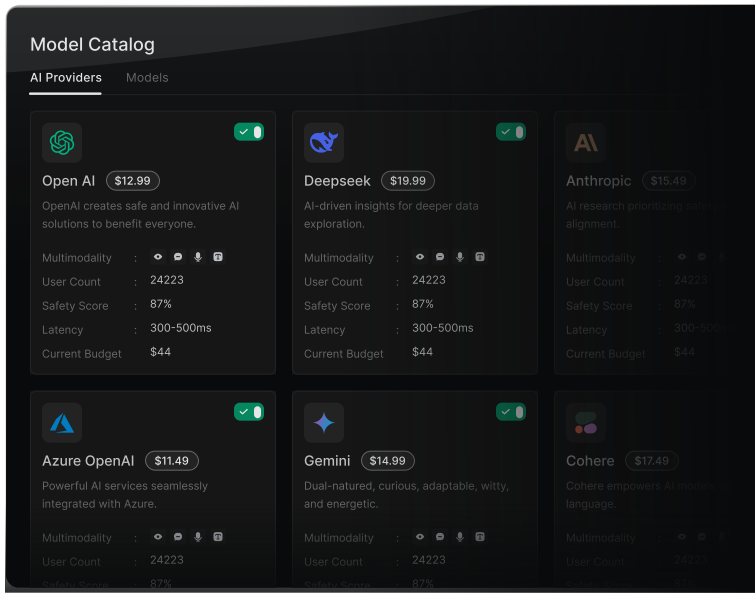
Seamlessly switch between OpenAI, Anthropic, Azure, and other providers with automatic failover. Route requests intelligently based on cost, latency, or availability.
Prompt Management
Prompt template management and versioning
Store, version, and organize prompt templates with variable substitution and A/B testing capabilities. Track changes and rollback to previous versions instantly.
Real-time usage monitoring and analytics
Track token consumption, API costs, and request latency across all connected providers. Get detailed insights into model performance and spending patterns.
Request caching and optimization
Reduce API calls and costs through intelligent prompt caching and response deduplication. Optimize latency with edge-based request handling.
Portkey Top Functions
Overview
Portkey is an AI gateway and prompt management platform designed to simplify LLM orchestration for development teams. It acts as a unified control layer between your applications and multiple LLM providers (OpenAI, Anthropic, Google, Azure, Cohere, etc.), enabling intelligent request routing, fallback mechanisms, and centralized prompt versioning. The platform abstracts away provider-specific API differences, allowing developers to switch models or providers with minimal code changes.
Beyond routing, Portkey provides enterprise-grade prompt management with version control, A/B testing capabilities, and collaborative editing. Teams can store, iterate, and deploy prompt templates from a single dashboard, with built-in monitoring for latency, cost, and token usage across all connected providers. The freemium pricing model makes it accessible to solo developers while offering advanced features for production teams.
Key Strengths
Portkey excels at multi-provider LLM orchestration with intelligent routing rules. You can define fallback chains (e.g., if OpenAI rate-limits, route to Anthropic), load-balance across providers, and implement cost optimization strategies without touching application code. The gateway handles authentication tokens securely, reducing credential management overhead.
The prompt management system is production-ready with Git-like version control, allowing teams to track prompt changes, revert to previous iterations, and maintain audit trails. Built-in analytics provide granular visibility into API costs, response latencies, and error rates per model, helping teams optimize spend and performance. The collaborative workspace supports real-time editing and approval workflows suitable for larger organizations.
- Multi-provider routing with automatic fallbacks and load balancing
- Prompt versioning with rollback and A/B testing capabilities
- Real-time analytics dashboard for cost and performance monitoring
- API caching to reduce redundant calls and lower costs
- Webhook integrations for observability and custom automation
Who It's For
Portkey is ideal for development teams building LLM-powered applications who need flexibility across multiple providers. It's especially valuable for teams that want to avoid vendor lock-in, reduce costs through intelligent routing, or implement sophisticated prompt experimentation workflows. Mid-size to enterprise organizations benefit from advanced monitoring, access controls, and approval workflows.
Individual developers and small startups can leverage Portkey's free tier to manage basic multi-provider scenarios and simple prompt templates. However, teams requiring only a single provider without advanced monitoring may find the added layer of abstraction unnecessary compared to direct API usage.
Bottom Line
Portkey is a mature, feature-complete AI gateway that solves real problems for teams managing multiple LLM providers at scale. The combination of intelligent routing, prompt management, and detailed analytics creates a compelling value proposition for production AI applications. It bridges the gap between development flexibility and operational visibility.
The freemium model and broad provider support make it a low-risk option for teams exploring LLM orchestration. For teams already deeply committed to a single provider with simple use cases, the added infrastructure complexity may not justify adoption, but for anyone managing prompts across environments or considering provider diversification, Portkey is a strong choice.
Portkey Pros
- Seamlessly routes requests across 20+ LLM providers without rewriting application code, reducing vendor lock-in risk.
- Prompt versioning with Git-style history allows teams to safely iterate on prompts with full rollback capability.
- Real-time cost analytics break down spend by provider and model, helping teams identify optimization opportunities immediately.
- Intelligent fallback chains automatically retry failed requests with alternative providers, improving reliability without manual intervention.
- Free tier includes generous monthly API calls and full access to core routing and prompt management features.
- Built-in prompt caching reduces redundant API calls and directly lowers LLM costs for repeated queries.
- Collaborative workspaces with approval workflows support team-based prompt development without version conflicts.
Portkey Cons
- Adds an extra network hop between your application and LLM providers, introducing potential latency overhead compared to direct API calls.
- Learning curve for teams unfamiliar with prompt versioning or multi-provider orchestration concepts; documentation could be more beginner-friendly.
- SDKs currently limited to JavaScript/TypeScript and Python; teams using Go, Rust, or other languages must use REST API directly.
- Free tier offers limited monthly API calls (exact limits vary); scaling beyond free tier requires paid plans with unclear pricing transparency.
- Monitoring and analytics dashboard has limited customization for exporting metrics or integrating with external BI tools.
- Less mature ecosystem compared to direct provider integrations; fewer community packages and third-party integrations available.
Get Latest Updates about Portkey
Tools, features, and AI dev insights - straight to your inbox.